The idea
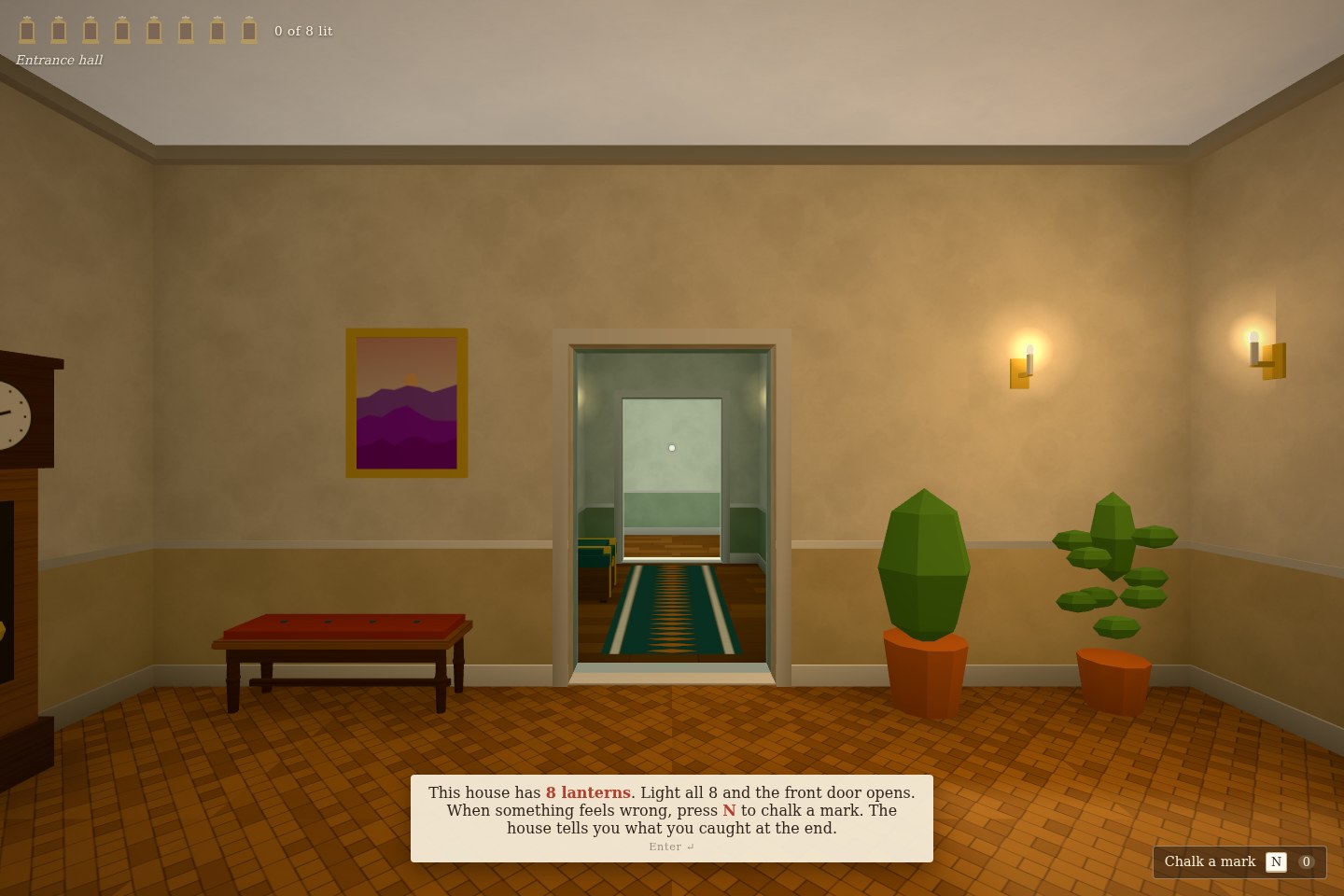
A closet opens into a cathedral. A corridor brings you home after three turns. A miniature house contains another miniature of itself. Impossible Rooms turns transformations into an exploration game: find lanterns, mark the moments that seem wrong and compare your observations when the house ends.
Geometry with an intentional contradiction
Each room is ordinary Euclidean geometry in its own frame. Doorways join those frames through rigid transforms and, for nested rooms, uniform scale. A seeded generator composes several architectural wings from nine kinds of spatial impossibility.
A recursive portal renderer maintains the view across doorways, while the world model checks reachability and records contradictions in the map. Ariadne’s thread follows the player through the rooms, so it can reappear somewhere it seems unable to belong. Architect mode lets visitors choose the ingredients of a house.
The collaboration
Claude Code led the experience, renderer and world presentation; Codex contributed topology and validity checking. The shared problem was to make the space impossible in the intended way while keeping traversal, goals and rendering coherent enough to explore.
Limitations
- Recursive rendering is bounded by depth and frame-time budgets.
- Performance and motion comfort vary by device; browser load checks do not replace extended playtesting.
Source code & evidence
Results reflect the linked evidence snapshots. Source artifacts retain their dates and experimental conditions.