A layout is only useful if it preserves the order
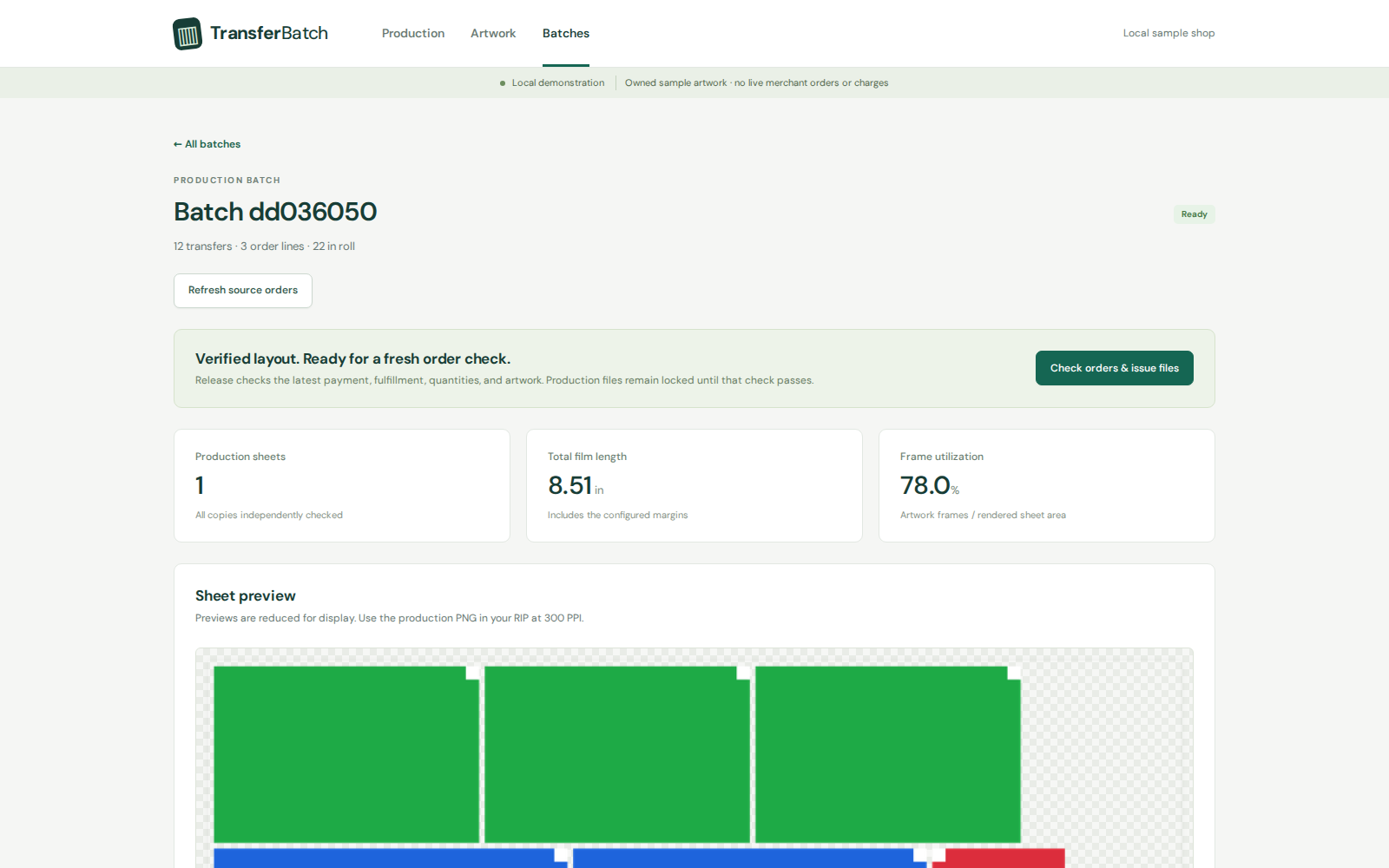
TransferBatch prepares batches of direct-to-film transfers from individual orders. Its central constraint is preserving what was ordered: the original artwork, exact copy counts, and physical dimensions. A compact sheet is useful only when those properties still hold.
The workflow separates preparation, verification, and issuance. Artwork is explicitly mapped to order lines; missing dimensions or mappings are not guessed by a model. The issued batch includes production artwork, copy-level traceability, and a manifest that records the files and their hashes.
Check the business state as well as the pixels
The system handles order revisions, allowance accounting, intentional reprints, cancellation, and private downloads. Issuing a batch creates an immutable artifact record. A later change or reprint has its own state instead of silently changing a file that may already be in a print shop's possession.
A real development-store order exercised the deployed workflow: 12 transfers across three line items were prepared, verified, and issued on one sheet. All seven output files matched their recorded hashes on repeated downloads. Cancelling a separate reprint returned its reserved allowance while preserving the original issued quantity.
Release state
The service is deployed and the Shopify integration has been exercised with a real test order. Commercial distribution and launch operations remain in preparation. The recorded checks establish the software workflow; they do not establish paid customer adoption or physical print quality.
Limitations
- The observed order used a zero-cost test subscription.
- No paid adoption or physical printing is claimed.
- Commercial plans, store review, and operational release work remain pending.
Source code & evidence
Results reflect the linked evidence snapshots. Source artifacts retain their dates and experimental conditions.