The idea
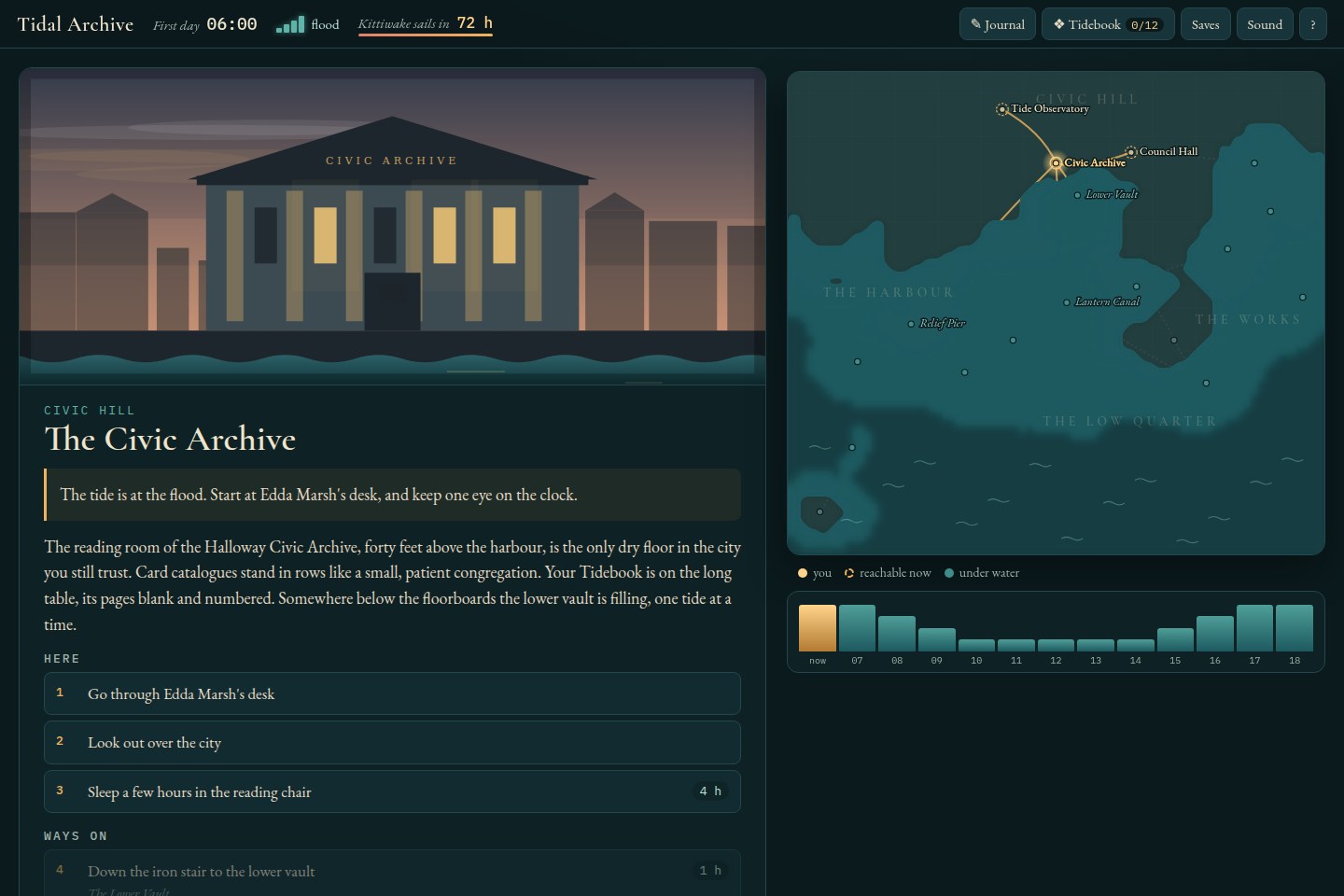
Halloway is drowning, and the relief boat leaves in three days. As its last archivist, you explore by tide, recover records, talk to the people who remain and decide what deserves a place in a twelve-page Tidebook. Routes, diving and mechanisms connect the passage of time to the story.
A world with explicit rules
A deterministic engine receives commands and produces the current view. The interface does not directly rewrite the world: travel, inventory, puzzle actions and ending conditions share the same state model. The map’s flooding is checked against the engine’s tide rules.
The authored world contains 18 places, 30 documents, five characters, six puzzles and seven endings. Scripted walkthroughs provide witnesses for reaching the endings; versioned saves and portable journey files let a player stop and return. The procedural scene art and synthesized atmosphere respond to location and water level.
The collaboration
Claude Code led the city, prose, interface, art and audio. Codex implemented the engine, validation, save semantics and bounded reachability analysis. Their contract joined a narrative author’s intentions to transitions the program could actually execute.
Limitations
- The general reachability search is bounded; walkthrough witnesses are not an exhaustive proof of every possible playthrough.
- Estimated play length and enjoyment have not been established through a human-player study.
Source code & evidence
Results reflect the linked evidence snapshots. Source artifacts retain their dates and experimental conditions.