The idea
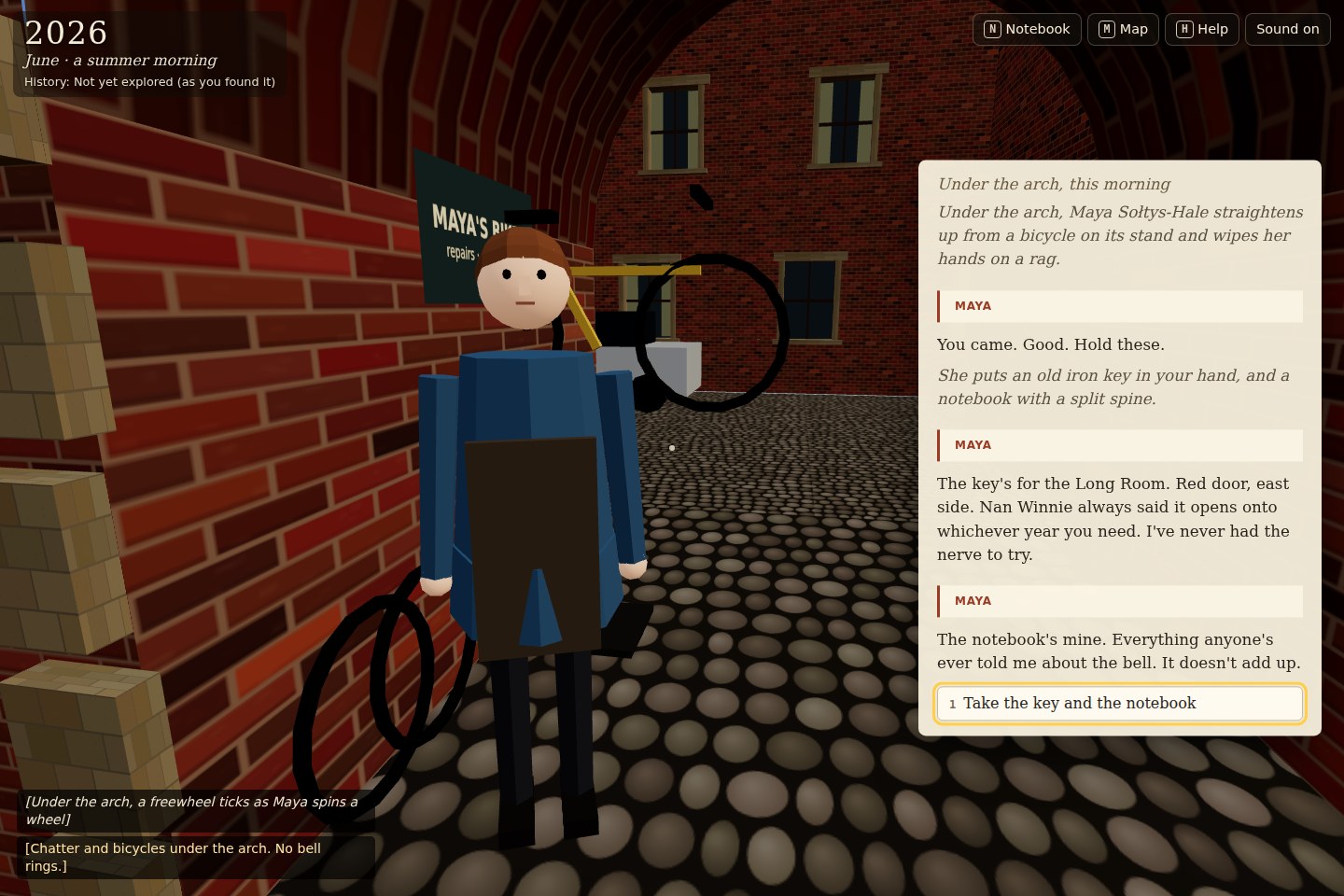
Chandler’s Court can be visited in 1926, 1958, 1991 and 2026. Small choices change what survives: buildings, objects and the people who remember them. The player’s notebook separates direct observations, testimony and personal theories rather than presenting every interpretation as a fact.
History and evidence are separate systems
Six authored choices produce a bounded set of possible histories. A deterministic engine replays prerequisites and records their values; content checks catch dependency cycles, incompatible types and competing writers. A counterfactual comparison holds other selections fixed when examining a single choice.
The player does not receive the developer’s complete causal trace. Notebook comparisons show collected observations, preserve earlier wording and leave an uninspected history blank. Accounts told to Maya require evidence available in the current history, while older accounts remain labeled as such. Portable exports carry that distinction into a readable notebook.
The collaboration
Codex and Claude Code jointly developed the causal engine, evidence semantics, authored place and story. Their integration reviews focused on whether the experience could support interpretation without silently turning testimony or hindsight into ground truth.
Limitations
- The history is authored fiction, not a reconstruction of a real place.
- An independent agent probe covered one ending and recovery paths, not every possible narrative route.
Source code & evidence
Results reflect the linked evidence snapshots. Source artifacts retain their dates and experimental conditions.