The idea
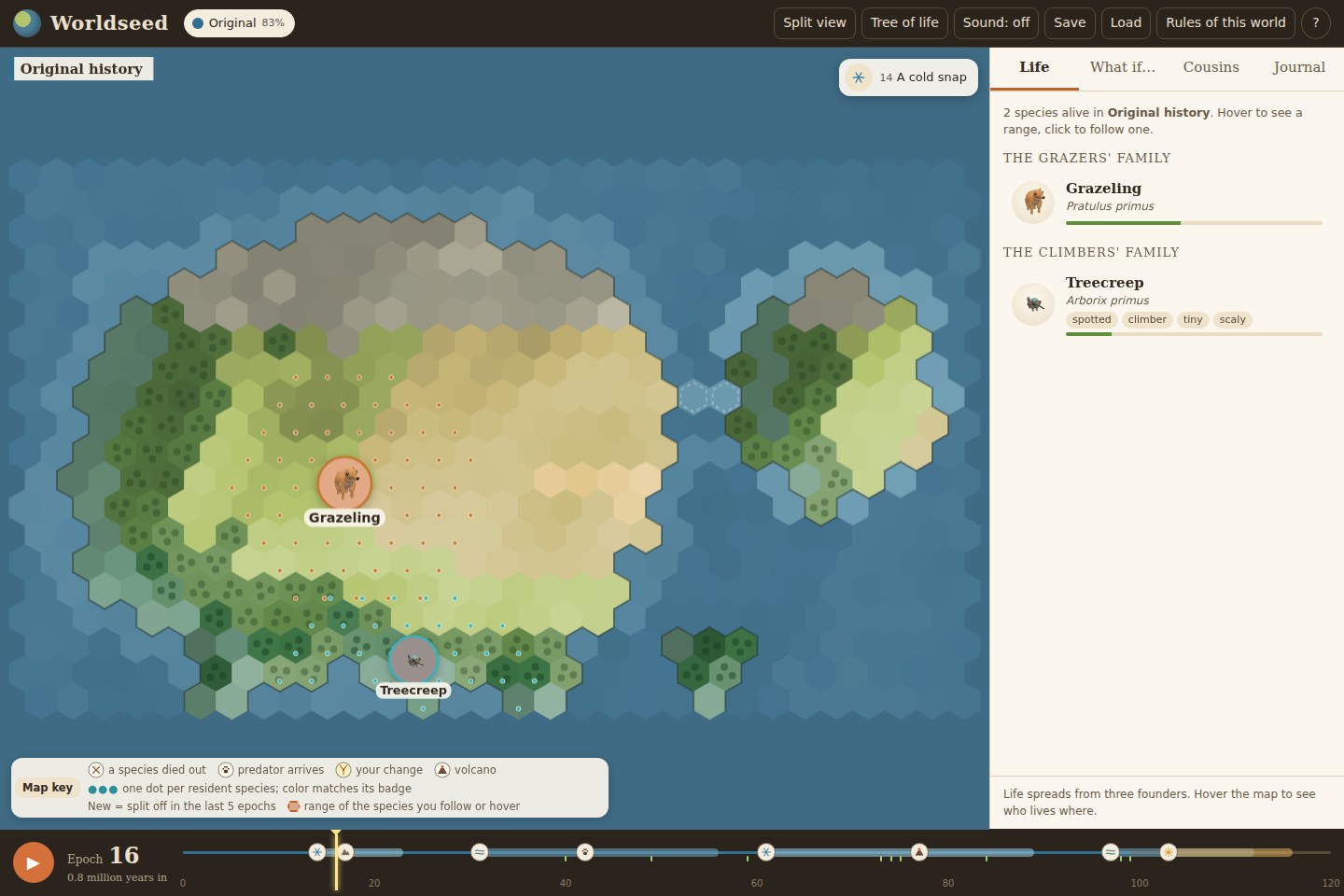
Watch a small world develop across 120 epochs, then fork its history: remove an ice age, change a land bridge or prevent a predator’s arrival. Compare descendant species, follow trait differences and enter the same region under two histories.
A comparison that means something
Worldseed uses explicit, bounded ecology and trait rules. Randomness is keyed by seed, epoch, lineage, region and purpose rather than consumed from one shared stream. A fork therefore avoids shifting unrelated random draws merely because another event occurred.
Branch storage, deterministic replay and causal traces support the comparison. The atlas exposes species ranges and event history; the cousins view connects related lineages across branches. Published rules explain what the toy world actually computes. This framing makes its limitations part of understanding the system.
The collaboration
Claude Code built geography, climate, evolution, creatures and the interface. Codex implemented branching, replay, lineage matching, trace queries and invariants. Together they treated an attractive world and a trustworthy comparison as separate requirements that had to meet.
Limitations
- The ecology is a deliberately simplified toy, not a validated biological model.
- Recorded cold replay performance misses the project’s original target; some extinction behavior remains narrower than intended.
- The atlas is best explored on desktop; the current mobile layout can clip dense controls.
Source code & evidence
Results reflect the linked evidence snapshots. Source artifacts retain their dates and experimental conditions.